


A bathroom mirror can clear while moisture remains on a cold wall, inside a poorly ventilated corner or on an absorbent surface. Conversely, a brief patch of mirror fog does not by itself describe the condition of the whole room. A useful moisture review follows where water enters, where it collects and how it leaves.
This is a building-comfort question before it is a choice of paint colour or cabinet finish. Good-looking surfaces are easier to maintain when the underlying moisture problem is understood. Begin with observations and the room’s ventilation route, rather than assuming that a coating can compensate for persistent dampness.
Separate water vapour from liquid water
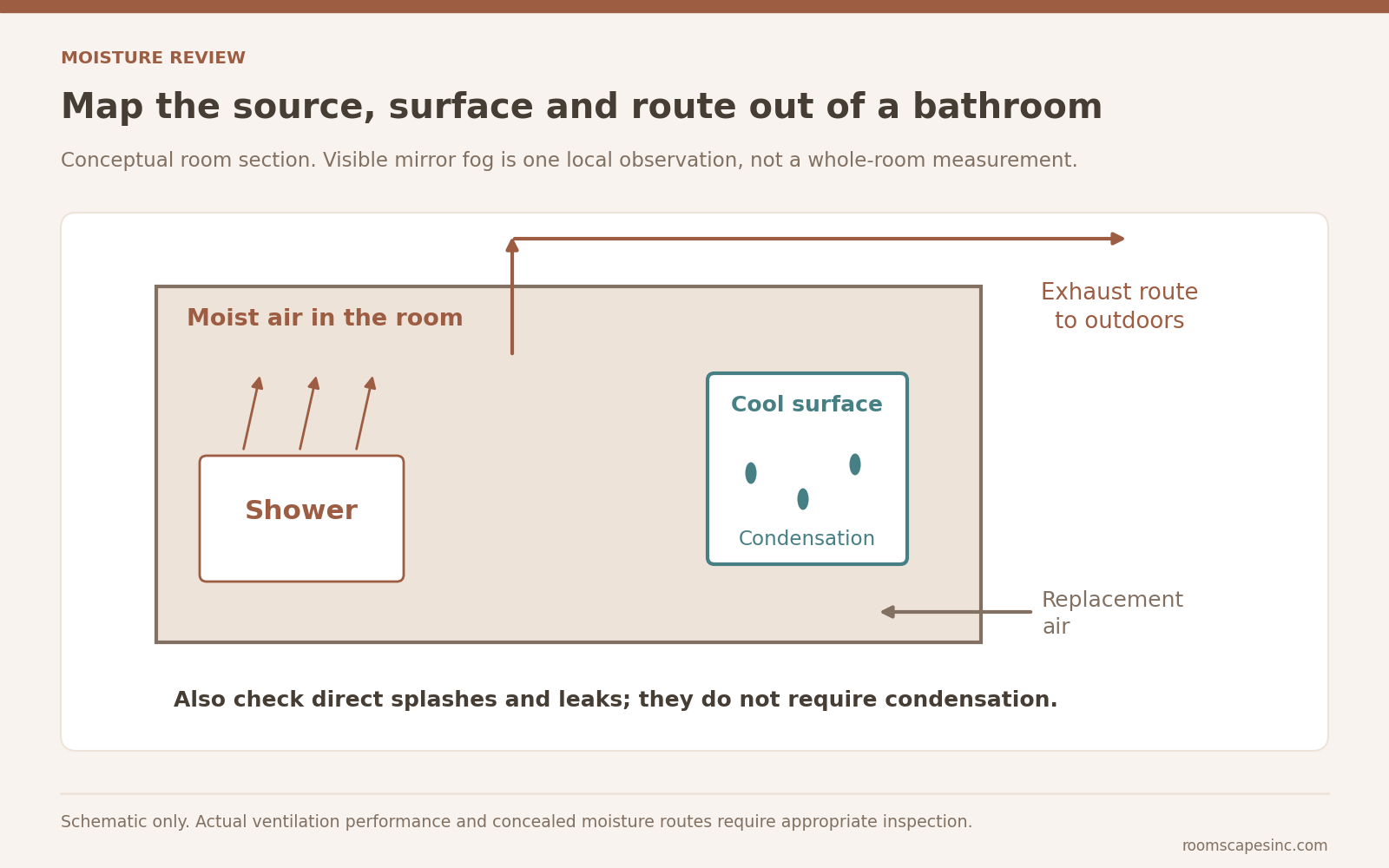
Warm shower water contributes water vapour to the surrounding air. When moist air encounters a sufficiently cold surface, some vapour can condense into liquid droplets. The droplets on a mirror are visible evidence of a local surface condition, not a measurement of humidity everywhere in the room.
Water can also arrive without condensation. A plumbing leak, splash from a basin or water passing a shower screen can wet a surface directly. Those routes may leave similar marks but require different responses. Record the location and timing of wetness before deciding which explanation fits.
For example, a mark that appears after every shower near a screen joint suggests a different investigation from a patch on an external wall that worsens during cold weather. Neither observation alone proves the cause, but each makes the next inspection more specific.
Relative humidity includes temperature
Relative humidity compares the water vapour present with the amount associated with saturation at that temperature. Temperature is therefore part of the reading. Air cooling near a surface can approach saturation even when a sensor elsewhere in the room shows a lower relative humidity.
A single reading beside a heater is not a complete description of a bathroom. Note where the sensor sits, when the shower was used and whether the room temperature changed. Place observations from the same location and time pattern together before comparing them.
The EPA’s guide to moisture and mold in homes emphasizes controlling moisture and addressing leaks or condensation. Its recommendations concern the conditions that permit growth, rather than treating every visible mark as the same problem.
Follow the ventilation path
An extractor is part of a route, not simply a grille on the ceiling. Air has to move from the room to an appropriate outdoor outlet, and replacement air must be able to enter. A fan that can be heard running does not establish that the intended airflow is occurring.
Inspect what is safely visible: whether the grille is obstructed, whether the fan operates when expected and whether condensation persists after use. A maintenance or ventilation professional can check the duct route, outlet and performance when those are uncertain. Avoid opening electrical equipment or concealed construction merely to complete a basic room review.
The EPA’s guidance on indoor environmental concerns during remodeling discusses moisture control and ventilation, including bathroom and kitchen exhaust to the outside. Planning the route during a renovation is easier than trying to correct a hidden discharge problem after cabinetry and finishes are complete.
Record a short sequence instead of one snapshot
Make a small log for several ordinary uses of the room. Record the approximate shower period, whether extraction was operating, the room’s temperature and humidity if measured, and the surfaces that remained wet. Avoid inventing precise numbers when the observation was simply “still damp.”
| Observation | Question it helps answer |
|---|---|
| Wetness appears during showering | Could splashing or condensation explain the location? |
| A patch remains wet between uses | Is there continuing moisture or poor drying? |
| The same corner stays cool and damp | Does the surface or airflow need closer inspection? |
The table is an organizing aid, not a diagnostic test. Its purpose is to give a contractor or building manager a reproducible description. Photos taken from the same angle can help show a change, provided that lighting differences are not mistaken for changes in the mark itself.
Allow for the response of the measuring device. A sensor moved from a dry hallway into a steamy bathroom may need time to reflect its new surroundings. Record that move rather than treating the first displayed value as an instant, complete measurement. Keep the sensor away from direct splashes unless it is designed for that exposure.
Compare similar uses of the room when judging a change. A short shower with the door open and a long shower with the door closed create different conditions. If several factors change together, a clearer mirror cannot establish which one made the difference. A short sequence of consistent observations is more useful than one unusually good result.
Let the moisture route inform the room layout
Storage placed tightly against a persistently damp surface can make inspection and drying harder. A towel left folded while wet may dry differently from one hung with space around it. These observations can inform everyday layout choices, but they should not distract from an unresolved leak or inadequate extraction.
During a redesign, consider access to joints, valves and ventilation equipment. A beautifully concealed component is inconvenient if routine inspection requires dismantling a fixed cabinet. Ask how the relevant parts will be cleaned and maintained before choosing the final arrangement.
Materials should be selected for the exposure they will actually experience. A surface occasionally splashed with water and a concealed area exposed to persistent moisture present different demands. Product instructions and competent installation matter more than a broad label such as “bathroom suitable.”
Distinguish a visible improvement from a resolved cause
Repainting a stain can change its appearance immediately. It does not demonstrate that the source of water has stopped. After any repair, repeat the observations under comparable use and weather conditions where possible. A successful change should make sense in relation to the identified route.
If moisture persists, return to the map: water source, air movement, surface temperature and drying path. That sequence gives a room project a practical foundation and prepares the ground for a separate discussion of dust, biological particles and how indoor exposures differ from the immune responses they may trigger.

